
Syllabus Spring 2021
Spring 2021, Tuesdays, 3:00 - 5:00 pm, via Zoom
Sessions will take place virtually at the Collection of Historical Scientific Instruments, with online excursions to the Harvard College Observatory and the Harvard Map Collection.
Instructor
Dr. Sara J. Schechner
schechn@fas.harvard.edu
Science Center 251c
Office Hours: By appointment
This hands-on course will introduce key episodes and issues in the history of American astronomy by close looking at rare early scientific instruments and tangible objects in Harvard collections. Starting with the story of Captain John Smith, Pocahontas, and a sundial, the course will move from colonial relations with Native Americans to the controversial placement of observatories on sacred mountaintops today. In between, we will discuss the roles of religion, politics, science, and culture in the promotion of astronomy in American society. Topics will include comets and extraterrestrials, observatories, westward expansion, time selling, and the role of women. Each unit will begin with anchoring objects, and students will work behind the scenes in the Collection of Historical Scientific Instruments. There will also be opportunities to make and use your own instruments to engage with early methods of production and observation.
What You Can Expect to Learn in This Course
Students in this course will not only learn about the history of American astronomy, but also how to read objects.
While most courses rely on historical texts to frame and develop lines of analysis and interpretation, this course focuses on material culture--i.e., objects and tangible things. Examples of things to be discussed in this course include scientific instruments, rare books and manuscripts, star maps, photographic negatives on glass plates, observatory buildings, paintings, a tea service, socks, a life mask, and a melted chunk of Sputnik. Such objects deepen and widen our appreciation of historical events and times in ways that texts simply cannot do.
You will also learn how to handle museum objects and document them. No longer will you be afraid to touch something 400 years old or readied for launch into space. You will also learn what goes on behind the scenes of a research museum and what best practices are.
And last but not least, you will learn what a tea pot has to do with a computer, and what Curious George has to do with modern astronomy.
Requirements
This course is a seminar in which we will engage in robust discussions of the objects in front of us and the required readings. Students are expected to participate fully in both synchronous and asynchronous course activities. These include:
- Class meetings and excursions. Students are expected to attend having already done the homework and reading assignments.
- Weekly Slack postings in the form of questions and reflections related to the reading, videos, or other assignments.
- Two short papers, 5-6 pages. Due February 26 and April 2.
- Oral report on an observatory, accompanied by a fact sheet to share with class.
- Final project. This may be a 10-12 pp. paper or virtual exhibit analyzing some instruments or objects in the context of American astronomy, or it can be a hands-on project such as making your own telescope mirror or creating a work of art. More will be said in good time. Due May 5.

Final course grades will be based on:
- Class Participation: 10%
- Slack Postings: 15%
- Short Paper I: 15%
- Short Paper 2: 15%
- Oral Report on an Observatory: 15%
- Final Project: 30% (proposal: 5%, faculty meeting: 5%, written paper, exhibit, or making project, 20%)
Required Books
- Laurel Thatcher Ulrich, Ivan Gaskell, Sara J. Schechner, and Sarah Anne Carter, Tangible Things: Making History Through Objects (New York: Oxford University Press, 2015).
- David Baron, American Eclipse: A Nation's Epic Race to Catch the Shadow of the Moon and Win the Glory of the World (New York: Liveright Publishing, 2017).
- Patrick McCray, Keep Watching the Skies! The Story of Operation Moonwatch and the Dawn of the Space Age (Princeton: Princeton University Press, 2008).
A link to these books at the Harvard Coop is https://tinyurl.com/W21-HSCI-123CS-1.
Recommended Resource
- Michael A. Hoskin, The Cambridge Illustrated History of Astronomy (Cambridge: Cambridge University Press, 1997).
All books are available on Reserve through the course website.
Other readings, videos, and visualizations will be available in the course Modules and Files sections.
Accommodations for Students with Disabilities
Students needing academic adjustments or accommodations because of a documented disability must present their Faculty Letter from the Accessible Education Office (AEO) and speak with the professor by the end of the second week of the term, February 5, 2021. Failure to do so may result in the Course Head's inability to respond in a timely manner. All discussions will remain confidential, although Faculty are invited to contact AEO to discuss appropriate implementation.
Meet the Faculty

Sara J. Schechner, Ph.D. is the David P. Wheatland Curator of the Collection of Historical Scientific Instruments, Harvard University and a Lecturer in the History of Science Department. A long time ago, she graduated from Harvard-Radcliffe, so-called because she was among the first students to gender-mix the College admissions process and dorm life in the Quad, Yard, and River Houses. Ask her about it! To learn more about her research, awards, and activities, please visit her website.
Course Schedule
More details about the goals and activities of each unit and week will be posted in the course modules. Use this list as a quick overview.
Unit 1. Colonial and Cultural Astronomy
January 26 Getting from Here to There | Navigation
February 2 Introduction to Tangible Things | Object Handling and Sorting
February 9 European Encounters with Native Americans | Sundials in Colonial America, Indigenous Cosmologies
February 16 Spectacle and Order | Religion and Nature, Comets and Eclipses, Maps and Orreries
Field Trip to Harvard Map Collection
Unit 2. Useful and Political Astronomy
February 23 Astronomy behind Enemy Lines | Transits of Venus and Solar Eclipse Expeditions
Short Paper 1 due February 26
March 2 The Observatory Movement | Harvard College Observatory
Field Trip to Harvard College Observatory to see the Great Refractor and Special Collections
March 9 Astronomy as Public Utility | The Bonds and Railroad Time, Clocks and Chronographs
Special Guests: Horologists Richard Ketchen and Donald Saff
March 16 Wellness Day, no class
Unit 3. A Place for Women and Extraterrestrials
March 23 Great American Eclipse | 1878 Eclipse Expedition
March 30 Extraterrestrials | Martians, the Moan Hoax, and SETI
Special Guest: SETI astronomer, Paul Horowitz
Short Paper 2 due April 2
April 6 Women & Astrophysics | Computers and Fly Spankers
Field Trip to Harvard College Observatory to see the Plate Stacks
Unit 4. Bigger Dimensions and Conflicts
April 13 Big Glass and a Bigger Universe | Mountaintop Observatories, Curtis-Shapley Debate
April 20 Cold War Astronomy | Operation Moonwatch
Special Guest: Moonwatcher astronomer, Jay Pasachoff
April 27 Whose Astronomy? | Maunakea
Last class. Student Reports on Final Projects
May 5 Final Projects Due
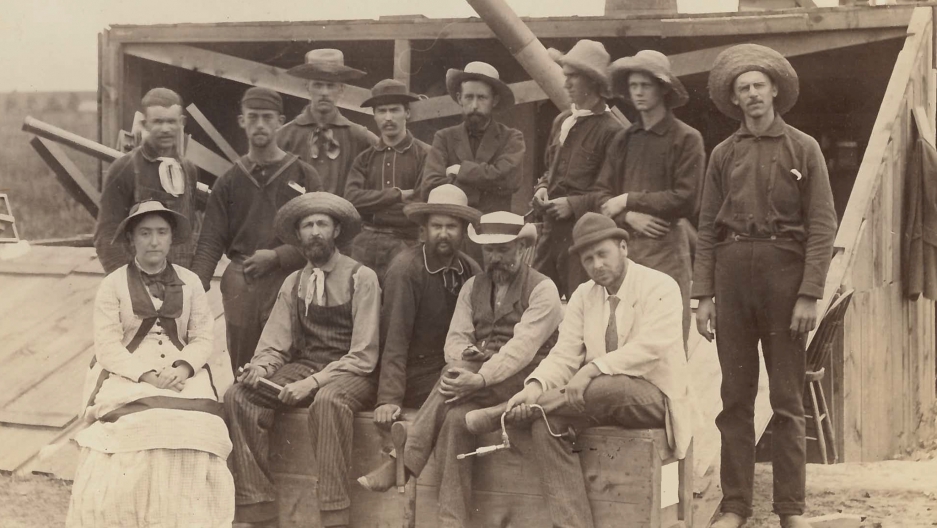
You did it! Try to look as happy as these intrepid eclipse chasers from Princeton!
Class:
Starstruck! The History, Culture, and Politics of American Astronomy